
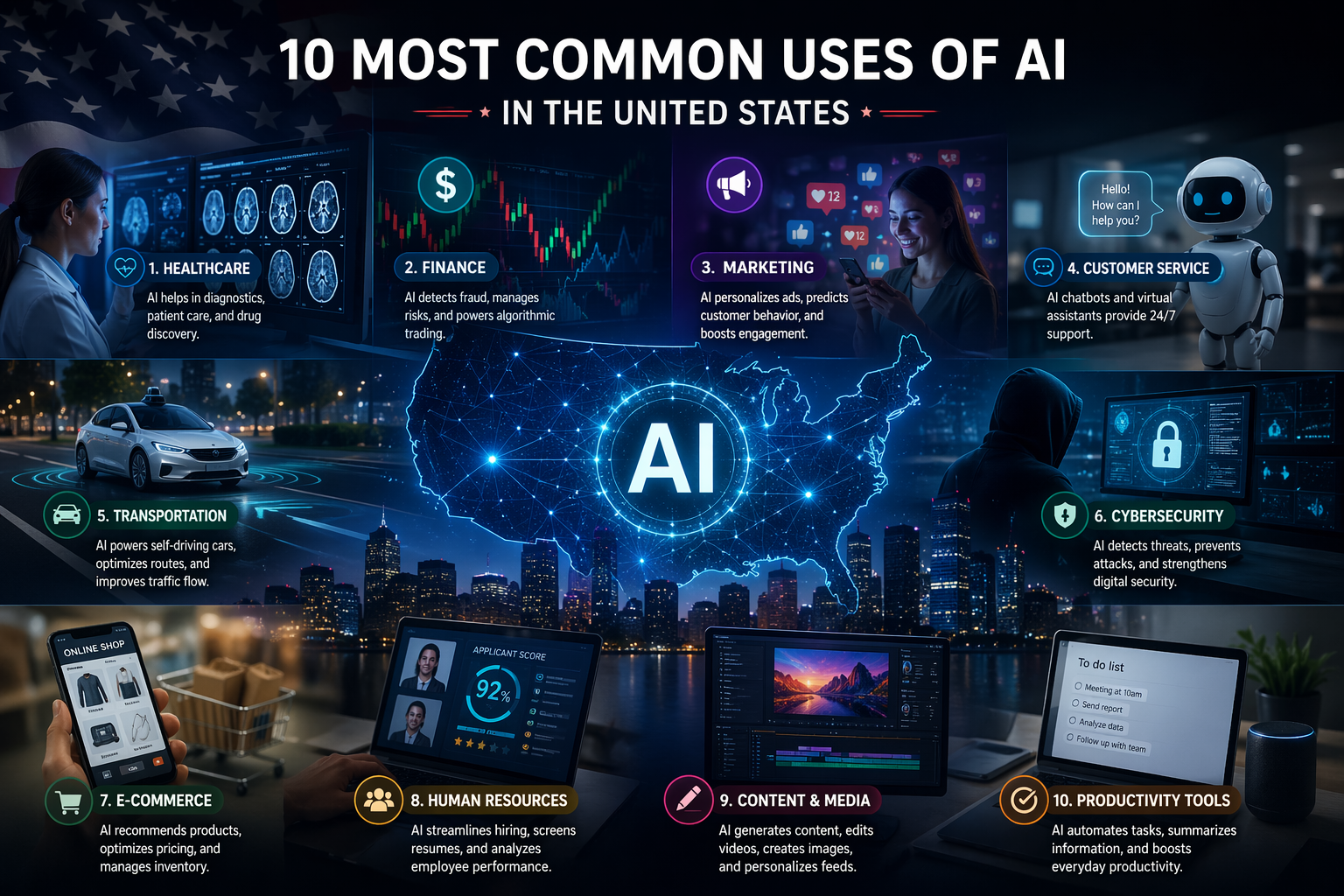
Artificial intelligence is no longer a future concept in the United States — it is embedded in daily life, business operations, and decision-making systems across industries.
From recommending what you watch to helping doctors detect diseases earlier, AI has become a foundational layer of the modern economy. Understanding how it is actually used — not just theoretically — is key to navigating opportunities and risks in 2026.
This article breaks down the 10 most common and impactful uses of AI in the United States, based on real-world adoption across industries.
1. Healthcare and Medical Diagnostics
AI is transforming healthcare by assisting in early diagnosis, treatment planning, and patient monitoring.
- Medical imaging analysis (X-rays, MRIs, CT scans)
- Predictive models for disease progression
- Personalized treatment recommendations
Benefit: Faster and more accurate diagnoses.
Risk: Bias in training data can affect outcomes.
Mechanism: Deep learning models trained on large clinical datasets.
2. Finance and Fraud Detection
Banks and fintech companies use AI to detect suspicious transactions and manage financial risk in real time.
- Fraud detection systems
- Credit scoring algorithms
- Automated trading strategies
Benefit: Reduced fraud and improved efficiency.
Risk: False positives affecting legitimate users.
Mechanism: Pattern recognition and anomaly detection.
3. Marketing and Personalized Advertising
AI powers targeted ads, customer segmentation, and content personalization across digital platforms.
- Recommendation engines (products, content)
- Customer behavior prediction
- Automated ad optimization
Benefit: Higher conversion rates.
Risk: Privacy concerns and over-targeting.
Mechanism: Behavioral data analysis and predictive modeling.
4. Customer Service and Chatbots
AI chatbots and virtual assistants handle millions of customer interactions daily.
- 24/7 customer support
- Automated FAQs and troubleshooting
- Voice assistants
Benefit: Scalability and cost reduction.
Risk: Poor user experience if not well trained.
Mechanism: Natural language processing (NLP).
5. Autonomous Vehicles and Transportation
Self-driving technologies and AI-assisted navigation systems are evolving rapidly in the U.S.
- Autonomous cars and trucks
- Traffic optimization systems
- Logistics route planning
Benefit: Increased efficiency and safety potential.
Risk: Regulatory and safety challenges.
Mechanism: Computer vision and real-time decision systems.
6. Cybersecurity and Threat Detection
AI is used to detect and respond to cyber threats faster than traditional systems.
- Malware detection
- Network anomaly monitoring
- Phishing detection
Benefit: Faster threat identification.
Risk: AI-powered attacks evolving simultaneously.
Mechanism: Behavioral analysis and anomaly detection.
7. E-commerce and Retail Optimization
Online retailers rely heavily on AI to optimize pricing, inventory, and customer experience.
- Dynamic pricing
- Inventory forecasting
- Personalized product recommendations
Benefit: Increased sales and efficiency.
Risk: Over-automation reducing human touch.
Mechanism: Demand prediction and recommendation systems.
8. Human Resources and Hiring
AI tools are widely used in recruitment processes across the United States.
- Resume screening (ATS systems)
- Candidate matching
- Interview analysis tools
Benefit: Faster hiring processes.
Risk: Algorithmic bias in candidate selection.
Mechanism: Natural language processing and scoring models.
9. Content Creation and Media
AI is transforming how content is created, edited, and distributed.
- Text generation (articles, scripts)
- Image and video generation
- Content recommendation algorithms
Benefit: Faster content production.
Risk: Misinformation and synthetic media concerns.
Mechanism: Generative AI models.
10. Everyday Productivity Tools
AI is now integrated into daily tools used by millions of Americans.
- Email writing assistants
- Scheduling and task automation
- Smart search and summaries
Benefit: Time savings and efficiency.
Risk: Over-reliance and reduced critical thinking.
Mechanism: Large language models and automation systems.
Conclusion
Artificial intelligence in the United States is no longer confined to tech companies — it is a cross-industry infrastructure shaping how people work, communicate, and make decisions.
Each use case offers clear benefits, but also introduces risks that require awareness and responsible implementation. The key is not to avoid AI, but to understand how it operates and where human judgment remains essential.
In 2026, the most valuable skill is not just using AI — it is using it consciously, strategically, and with clarity.
FAQ
Is AI widely used in the United States?
Yes. AI is integrated across healthcare, finance, marketing, and everyday digital tools.
What industry uses AI the most?
Healthcare, finance, and technology sectors are among the most advanced adopters.
Is AI replacing jobs in the U.S.?
AI is transforming jobs more than replacing them entirely, creating new roles while automating repetitive tasks.
Can individuals benefit from AI?
Yes. From productivity tools to career optimization, AI is accessible to individuals, not just companies.


